

The Waves, Instabilities, and Noise Spectrometer (WINS) project’s primary objective is developing a highly compact, cost-effective cubesat instrument capable of measuring plasma density, temperature, and wave signatures in Earth’s ionosphere.
WINS, led by PI Mihailo Martinović from the University of Arizona, leverages a Thermal Noise Receiver to capture high-frequency electric field spectra across a broad frequency range – from 32 kHz to 32 MHz at up to 512 Hz cadence. With a dynamic range of 90 dB and virtually negligible noise, WINS enables high-cadence mapping of Velocity Distribution Functions, capturing the distribution of electrons, ions, and protons at varying plasma velocities via multi-point measurements. By the end of its NASA Heliophysics Division HESTO Heliophysics Technology and Instrument Development for Science (HTIDS) grant period, WINS (22-HTIDS22-0013) had advanced to Technology Readiness Level (TRL) 3, and under additional internal university funding, the team successfully completed TRL 4 testing in April 2026.
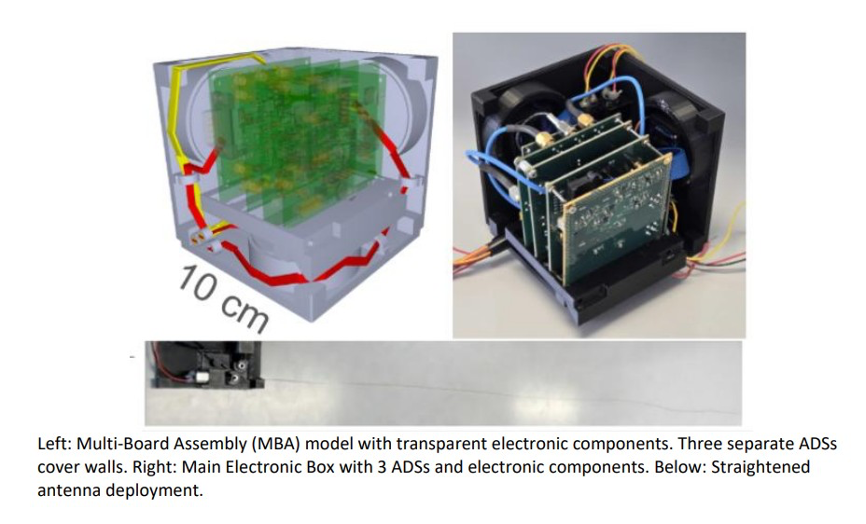
Another WINS accomplishment is development of a novel antenna deployment system, featuring three 2-meter long, ultra-thin beryllium-copper wire antennas. This mechanism allows for three distinct dipole measurement options using two antennas at a time. WINS handles data processing efficiently through Fast Fourier Transforms on the Field-Programmable Gate Array, and the team has managed to eliminate power supply noise during testing, resulting in clean electric field signals.
The compactness and affordability of WINS make it possible to deploy multiple units simultaneously in constellation configurations, enabling multi-point in situ measurements, and greatly expanding mission potential. WINS has also attracted attention from the Department of War’s Space Force for its capability in detecting and tracking radio signatures, broadening its relevance beyond NASA Heliophysics.
NASA Artificial Intelligence (AI) Usage Disclosure: This article was created with assistance from AI (ChatGSFC) to summarize content from multiple sources. The resulting article has been reviewed and edited by the author team.