

The Plasma Observatory for Lunar Exploration (POLE) mission, selected April 1, 2026, will complete development within an aggressive one-year schedule, delivering flight-ready hardware by late March 2027. POLE embodies a “sounding rocket to the Moon” fast path to science philosophy, leveraging agile development practices, rapid technology maturation, and proven flight heritage to deliver high-value scientific measurements on an accelerated timeline and at reduced risk. This rapid development directly demonstrates the benefit of Heliophysics Technology Program (HTP) investments into NASA’s lunar exploration portfolio by adapting cutting-edge instruments matured through HTP’s Low-Cost Access to Space (LCAS) sounding rocket program.
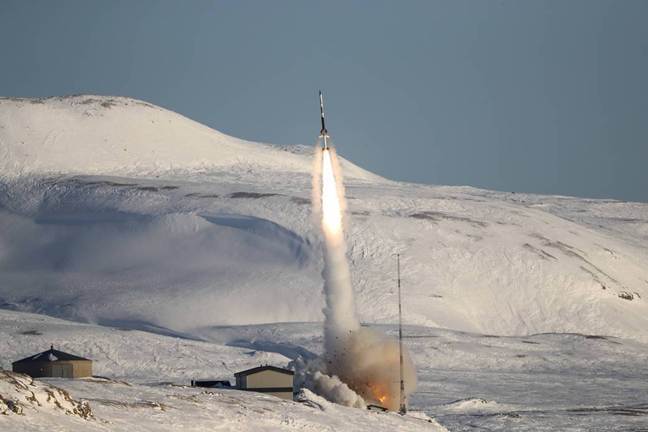
The Endurance rocket – on a mission to understand why Earth is habitable launched May 2022.
POLE’s instrument suite traces its roots to three LCAS sounding rocket investigations that advanced plasma measurement technologies in space and demonstrated their readiness for more ambitious exploration missions.
The POLE Space Weather Package incorporates heritage from the Ion Electrostatic Analyzer (IEA) flown on the Ground Imaging to Rocket Investigation of Auroral Fast Features (GIRAFF) sounding rocket mission. Led by Principal Investigator (PI) Robert Michell of NASA’s Goddard Space Flight Center (GSFC) and launched in January 2025, GIRAFF successfully advanced ion plasma measurement capabilities in Earth’s upper atmosphere. POLE now uses this heritage to characterize the lunar plasma environment and monitor the space weather conditions that influence surface charging, dust transport, and astronaut operations during future Artemis missions.
A second POLE infusion comes from the Dual Electrostatic Analyzer (DESA) Photoelectron Spectrometer (PES), which was successfully demonstrated July 2021 on the Dynamos, Winds, and Electric Fields in the Daytime Lower Ionosphere-2 (DYNAMO-2) sounding rocket mission. Led by PI Rob Pfaff (NASA’s GSFC), DYNAMO-2 validated the instrument’s ability to obtain high-quality calibrated measurements of low-energy photoelectrons in space. The mission provided critical flight heritage for the PES technology now incorporated into POLE, enabling detailed investigations of electron populations and plasma processes in the lunar near-surface environment.
POLE also leverages technology heritage from the Endurance sounding rocket mission, led by PI Glyn Collinson (NASA’s GSFC), which launched from Svalbard, Norway, on May 10, 2022. Endurance carried a suite of instruments designed to make the first direct measurements of Earth’s global electric potential, an extraordinarily weak electric field that influences the motion of charged particles throughout the atmosphere and is thought to play a role in maintaining the conditions that make Earth habitable. During its successful flight to an altitude of approximately 475 miles, Endurance returned valuable scientific data while demonstrating advanced plasma diagnostic technologies in a challenging space environment.
POLE builds directly upon this heritage using both the Photoelectron Spectrometer (PES) and Swept Langmuir Probe (SLP) technologies. On Endurance, these instruments worked together to characterize key plasma parameters and support the mission’s electric potential measurements. The SLP provided measurements of plasma density, temperature, and electric potential, while the PES demonstrated the ability to observe low-energy photoelectron populations critical to understanding plasma behavior. POLE now adapts these proven technologies to the lunar environment, where they will provide unprecedented measurements of the near-surface plasma sheath, surface charging processes, and the plasma conditions that future Artemis astronauts and lunar assets will experience.
Together, the GIRAFF, DYNAMO-2, and Endurance technologies provide POLE with a uniquely capable suite of plasma diagnostics for investigating the lunar environment. By combining ion, electron, and plasma measurements derived from successful LCAS missions, POLE will characterize the processes that govern surface charging, dust transport, and the near-surface plasma sheath at the Moon. These observations will improve our understanding of the lunar space environment while providing critical data needed to support the safety and success of future Artemis surface operations.
NASA Artificial Intelligence (AI) Usage Disclosure: This article was created using AI (ChatGSFC/Gemini 3.1 Pro) to summarize content from multiple sources. The resulting article was reviewed by the author.