
The Princeton Plasma Physics Laboratory (PPPL) Facility for Laboratory Reconnection Experiments (FLARE) is advancing its capabilities through the NASA Heliophysics Technology (HESTO) Heliophysics Technology and Instrument Development for Science (H-TIDeS) program. The FLARE facility is adding soft X-ray tomography, electron energy analyzers, and sophisticated Artificial Intelligence (AI) models to enable non-invasive mapping of superheated plasma and the multiple X-line magnetic reconnection process, providing an unprecedented window into these explosive events.
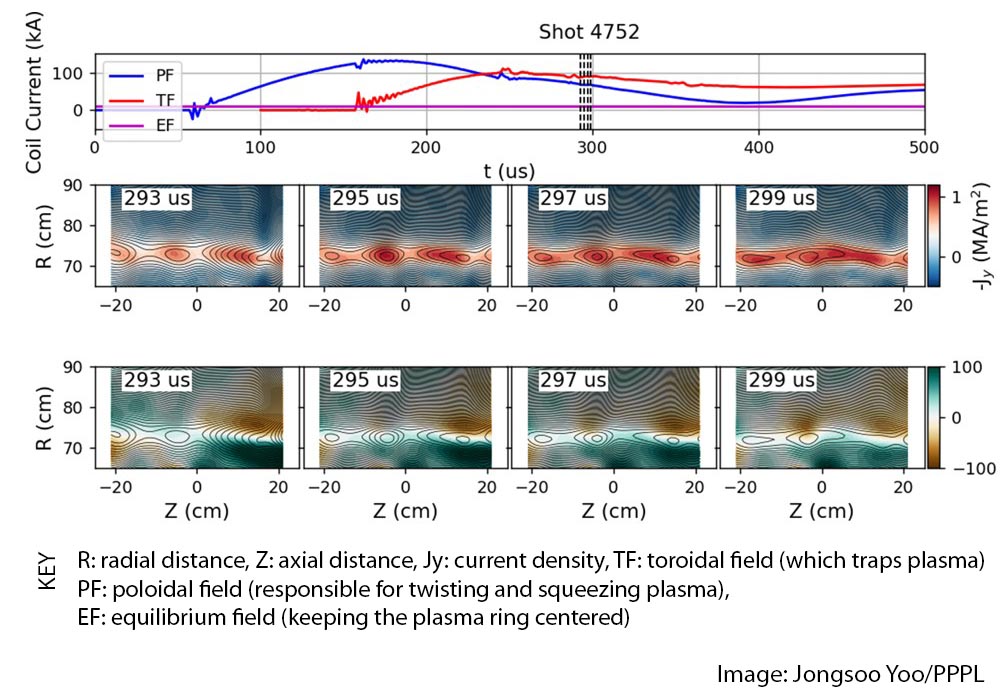
NASA is strategically leveraging prior US Department of Energy (DOE) investments into FLARE, creating results that benefit both agencies and our nation. By revealing the physics behind snapping magnetic fields and the intricate formation of plasmoids, this research offers the potential to help scientists mitigate disruptive events in nuclear fusion reactors. FLARE will also play a pivotal role in safeguarding our national power grid against the threat of catastrophic solar storms.
In addition, integrating laboratory ground-truth data into NASA analysis pipelines will enable direct comparison with in situ data from the Magnetospheric Multiscale (MMS) mission. FLARE has recently produced and measured multiple plasmoids in a laboratory reconnection experiment, opening a path to directly connecting laboratory ground-truth measurements with NASA-relevant reconnection processes observed by missions like MMS. This approach promises to enrich our understanding and inform the design and analysis strategies for current and future Heliophysics missions.
NASA Artificial Intelligence (AI) Usage Disclosure: This article was created with assistance from AI (ChatGSFC) to summarize content from multiple sources. The resulting article has been reviewed and edited by the author team.