


The Heliophysics Strategic Technology Office (HESTO) tracks technologies that move from the Heliophysics Technology Program (HTP) into real space missions. We call this process “infusion.” HESTO finds and confirms these milestones by managing projects, hosting technology events, talking to past researchers, and watching for new NASA and partner missions.
HTP Technology Infusions: Powering the Next Generation of Heliophysics Discoveries
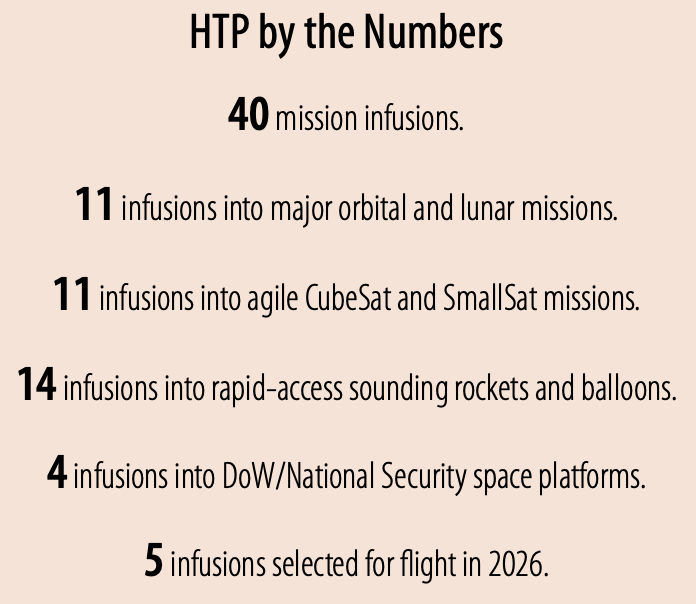
As of September 2026, HTP has successfully placed 40 advanced technologies into space missions. This moves new tools straight from the lab to the launchpad. Many new ideas fail because they run out of funding before they can fly, a gap known as the “valley of death.” HTP bridges this gap. By doing so, HTP cuts down the time it takes to get from a basic idea to a working flight mission, bringing us scientific results faster than ever. These quick flight opportunities are already creating major scientific breakthroughs.
Instruments developed by HTP have solved decades-old mysteries in Earth’s radiation belts. They have also mapped the magnetic forces behind solar flares and taken pure plasma readings in space. Today, HTP funds are making it possible to build major orbital observatories, explore the Moon’s surface, fly on commercial rockets, and support defense platforms.
Reducing Time to Science through Technology Development
Enabling Major Space and Lunar Missions
Technologies developed by HTP now serve and will serve critical roles on major NASA and international space missions. While many act as the primary science tools capturing vital space weather data, others provide the highly precise calibration required to make those missions successful.
Martian Atmosphere (ESCAPADE): Put LLITED sensors (PI: Aroh Barjatya) on the ESCAPADE Small Explorer to study Mars’ unique magnetic field.
Deep-Space Radiation (EMA): Will put the REPTile-3 particle telescope (PI: Xinlin Li) on the Emirates mission to the Asteroid Belt. This will measure radiation deep in space out to 3 AU.
Artemis Lunar Exploration: Will put the DUSTER meteoroid sensor (PI: David Malaspina) on an Artemis Lunar Rover to keep astronauts safe.
Major Solar Observatories: Applied EUV Photon Sieves (PI: Adrian Daw) to the Multi-Slit Solar Explorer (MUSE). Also, will add advanced CMOS cameras to the STRUVE Explorer (PI: Alfred de Wijn).
L1 Space Weather Sentinels: Will put advanced charged particle instruments (PI: Christopher Mouikis) on the NOAA SOLAR-2 and SOLAR-3 spacecraft. These will help protect Earth from solar storms.

Growing Defense and Commercial Partnerships
HTP works with commercial space stations and Department of Defense (DoD) rideshares. This teamwork gets science into space faster and cheaper, proving our technologies are useful to multiple agencies.
L1 Space Weather Sentinels: Will put advanced charged particle instruments (PI: Christopher Mouikis) on the NOAA SOLAR-2 and SOLAR-3 spacecraft. These will help protect Earth from solar storms.
Commercial Platforms: Will put the Quad-Mag magnetometer (PI: Mark Moldwin) on the commercial Aethero platform. Also, will add the DWTS instrument (PI: Larry Gordley) to a private U.S. spacecraft.

Driving the CubeSat and SmallSat Revolution
HTP often shrinks key technologies, so they fit on small satellites. This supports the growing SmallSat industry and lets scientists do world-class research quickly, without waiting years for a larger flagship mission.
Ionosphere/Thermosphere Dynamics: Put the LLITED instrument suite (PI: Aroh Barjatya) on a dual-CubeSat mission to study the upper atmosphere near the equator.
Space Weather Networks: Will put the DWTS Doppler Wind and Temperature Sounder (PI: Larry Gordley) on small platforms like Aeolus-Mars and TechEdSat 16.
Solar Observatories: Added advanced EUV coatings to the SunCET CubeSat (PI: David Windt) to track Coronal Mass Ejections.
Radiation and Plasma Tracking: Put HTP instruments on the CIRBE (PI: Xinlin Li) and REAL (PI: Robyn Millan) CubeSats to map the Van Allen Belts. (Note: CIRBE recently discovered new radiation belts after a May 2024 solar storm, leading to two published papers in Nature).

Using Suborbital Missions and Balloons
HTP uses sounding rockets and high-altitude balloons to quickly and inexpensively test highly experimental technologies in flight.
Resolute (Erebus) Sounding Rocket Campaign: Will put a large group of HTP technologies, including Double Langmuir Probes (PI: Robert Clayton), the HYPERION instrument (PI: Glyn Collinson), and Hybrid AC/DC Magnetometers (PI: Mark Moldwin), onto a single rocket mission.
High-Altitude Balloons: Flew the High-Frequency Magnetic Loop (PI: Ethan Tsai) to study electron losses, and preparing to launch the High-Rate X-ray Spectrometer (PI: Lindsay Glesener) as a piggyback experiment to capture impulsive solar flares.
Next-Gen Solar Rockets: Flew the ORIGIN-2 payload (PI: Konstantinos Kalogerakis) to study atmospheric emissions, and preparing to fly the ESIS-II payload (PI: Jacob Parker) for an upcoming rocket flight to study the Sun’s transition region.
Detailed Data (Infusions with *** were selected for flight in 2026)
| Infusion | PI Name/Institution | HTP # | Project | Mission Infused/Type | Launch Date/Select Date |
| 1 | Aroh Barjatya, Embry-Riddle Aeronautical University | 16-HTIDS16_2-0024 | Low-Latitude Ionosphere/Thermosphere Enhancements in Density (LLITED) | LLITED Dual CubeSat Mission, HTIDS, CubeSat | 4/15/23, 12/7/16 |
| 2 | Aroh Barjatya, Embry-Riddle Aeronautical University | 16-HTIDS16_2-0024 | Low-Latitude Ionosphere/Thermosphere Enhancements in Density (LLITED) | Escape and Plasma Acceleration and Dynamics (ESCAPADE), Small Explorer (SMEX), Spacecraft | 11/13/25, 6/20/19 |
| 3 | Pascal Saint-Hilaire, University of California, Berkeley Space Science Lab | 17-HTIDS17-0002 | Preparing the next iteration of the Gamma-Ray Imager/Polarimeter for Solar flares (GRIPS) | Compton Spectrometer and Imager (COSI), Astrophysics Small Explorer (SMEX), Spacecraft | 2027, 10/18/21 |
| 4 | Mark Moldwin, University of Michigan, Ann Arbor | 17-HTIDS17-0010 | Development of a new Research Quality, Low-Cost Inductive Magnetometer for Heliophysics Missions | Auroral Waves Excited by Substorm Onset Magnetic Events (AWESOME), LCAS, Sounding Rocket | 3/3/25, 7/14/20 |
| 5 | Xinlin Li, University of Colorado, Boulder/ LASP | 17-HTIDS17-0028 | Relativistic Electron and Proton Telescope integrated little experiment (REPTile)-2 | CubeSat: Inner Radiation Belt Experiment (CIRBE), H-FORT, CubeSat | 4/15/23, 3/15/18 |
| 6 | Xinlin Li, University of Colorado, Boulder/LASP | 17-HTIDS17-0028 | Relativistic Electron and Proton Telescope integrated little experiment (REPTile)-2 | Emirates Mission to the Asteroid Belt (EMA), Foreign Gov., Spacecraft | 3/15/28, 9/4/24 |
| 7 | Robyn Millan, Dartmouth College | 17-HTIDS17-0031 | The Relativistic Electron Atmospheric Loss (REAL) Cubesat | Relativistic Electron Atmospheric Loss (REAL), H-FORT, CubeSat | 7/24/25, 3/5/18 |
| 8 | Adrian Daw, NASA’s Goddard Space Flight Center | 17-HTIDS17-0046 | EUV Photon Sieves for Milli-Arcsecond Imaging of the Solar Corona | Multi-Slit Solar Explorer (MUSE), Medium Explorer (MIDEX), Spacecraft | 2027, 2/10/22 |
| 9 | Juan Carlos Oliveros, University of California, Berkeley/SSL | 17-HTIDS17-0048 | Development and Characterization of the Timepix X-ray Sensor Assembly (TXSA) | PolArization and Directivity X-Ray Experiment (PADRE), H-FORT, Cubesat | 6/1/25, 3/15/21 |
| 10 *** | Larry Gordley, G&A Technical Software, Inc. | 17-HTIDS17-0081 | DWTS: Doppler Wind and Temperature Sounder | NASA Aeolus – Mars Mission, US Public/Private Partnership with Relativity Space, Spacecraft | 2028, 6/17/26 |
| 11 *** | Larry Gordley, G&A Technical Software, Inc. | 17-HTIDS17-0081 | DWTS: Doppler Wind and Temperature Sounder | DWST-Helio, H-FORT, CubeSat | Sep. 2028, 5/31/26 |
| 12 | Larry Gordley, G&A Technical Software, Inc. | 17-HTIDS17-0081 | DWTS: Doppler Wind and Temperature Sounder | TechEdSat 16, STMD, CubeSat | TBD (Original planned launch Jan. 2024, Aug. 2023 |
| 13 | David Miles, University of Iowa | 18-HTIDS18-0010 | CHIMERA: A hybrid search coil and fluxgate magnetometer for small spacecraft missions | Aurora Current and Electrodynamics Structure (ACES) 2, LCAS, Sounding Rocket | 11/20/22, Likely 2018 |
| 14 | David Miles, University of Iowa | 18-HTIDS18-0010 | CHIMERA: A hybrid search coil and fluxgate magnetometer for small spacecraft missions | ICI-5b, Foreign Gov., Sounding Rocket | 3/6/26, Aug. 2024 |
| 15 | David Miles, University of Iowa | 18-HTIDS18-0010b | Space Weather Iowa Instrument (SWIM) | ICI-5b, Foreign Gov., Sounding Rocket | 3/6/26, Aug. 2024 |
| 16 | David Miles, University of Iowa | 18-HTIDS18-0010b | Space Weather Iowa Instrument (SWIM) | OCHRE (formerly called TRAcers Student Rocket (TRA-SR)), LCAS, Sounding Rocket | 1/27/27, 8/14/23 |
| 17 | David Windt, Reflective X-Ray Optics LLC | 18-HTIDS18-0040 | Broadband EUV multilayer coatings for high-resolution spectroscopy near 30 nm | The Sun Coronal Ejection Tracker Concept (SunCET), H-FORT, CubeSat | 3/15/27, 5/16/22 |
| 18 | Shri Kanekal, NASA’s Goddard Space Flight Center | 18-HTIDS18-0066 | AGILE: Advanced enerGetic Ion eLectron tElescope | GenSat-1, US Private, CubeSat | Spring 27, Likely 2023 |
| 19 | Chris Moore, Harvard-Smithsonian Astrophysical Observatory | 19-HTIDS19-0017 | Technology Development of High-Speed CMOS Detectors and Multilayer Mirrors for Dynamic Solar Soft X-ray Spectral Imaging | HI-C Flare, LCAS, Sounding Rocket | 4/17/24, 7/14/20 |
| 20 | Alfred de Wijn, University Corporation for Atmospheric Research (UCAR) | 20-HFOS20-0002 | The Solar Transition Region Ultraviolet Explorer | The Solar Transition Region UltraViolet Explorer (STRUVE), H-FORT, CubeSat | 10/5/29, 7/1/25 |
| 21 *** | Redacted | Redacted | Redacted | Redacted for Competition Sensitivity | Redacted |
| 22 | John Bonnell, University of California, Berkeley/SSL | 20-HTIDS20-0010 | LIEFSI – Laboratory Investigation of Electric Field Sensor Instabilities | TRACERS, Small Explorer (SMEX), Spacecraft | 4/1/25, 6/20/19 |
| 23 | Carlos Maldonado, Triad National Security, LLC | 20-HTIDS20-0012 | A Compact Ion Mass Spectrometer (CIMS) for Ionospheric Outflow and Cold Magnetospheric Plasma Measurements | Experiment for Space Radiation Analysis (ESRA), DoD, CubeSat | 4/15/27, 1/31/24 |
| 24 | Carlos Maldonado, Triad National Security, LLC | 20-HTIDS20-0012 | A Compact Ion Mass Spectrometer (CIMS) for Ionospheric Outflow and Cold Magnetospheric Plasma Measurements | Space Test Program Houston 11, DoD, Space Station (ISS) | 5/15/26, Jul. 2024 |
| 25 *** | Carlos Maldonado, Triad National Security, LLC | 20-HTIDS20-0012 | A Compact Ion Mass Spectrometer (CIMS) for Ionospheric Outflow and Cold Magnetospheric Plasma Measurements | Space Test Program H13, DoD, Space Station (ISS) | 8/14/28, 4/8/26 |
| 26 | Robert Michell, NASA’s Goddard Space Flight Center | 20-HTIDS20-0021 | Multi Look-Direction Magnetic Electron Spectrometer for Auroral Studies | Ground Imaging to Rocket investigation of Auroral Fast Features (GIRAFF), LCAS, Sounding Rocket | 1/21/25, 7/24/20 |
| 27 | Christopher Mouikis, University of New Hampshire, Durham | 20-HTIDS20-0031 | Increasing the dynamic range of spaceflight charged particle instruments | Space weather Observations at L1 to Advance Readiness (SOLAR-2), NOAA, Spacecraft | 2029, 10/24/24 |
| 28 | Christopher Mouikis, University of New Hampshire, Durham | 20-HTIDS20-0031 | Increasing the dynamic range of spaceflight charged particle instruments | Space weather Observations at L1 to Advance Readiness (SOLAR-3), NOAA, Spacecraft | 2032, 10/14/24 |
| 29 | Ethan Tsai, University of California, Los Angeles | 21-HTIDS21-0004 | High-Frequency Magnetic Loop for Heliophysics Exploration | Electron Losses driven by VLF Emissions (ELVES), TechLeap, Balloon | 9/15/25, Likely 2023 |
| 30 | James Clemmons, University of New Hampshire, Durham | 21-HTIDS21-0012 | Low-resource instrumentation for scientific measurements in planetary thermospheres | Dynamo-3, LCAS, Sounding Rocket | 6/14/27, 7/7/25 |
| 31 | Andrew Nicholas, Navy Research Laboratory | 22-HTIDS22-0006 | Lightsheet Anomaly Resolution And Debris Observation – Neuromorphic | Space Test Program Sat-7, DoD, Spacecraft | 4/7/26, 4/8/25 |
| 32 | Konstantinos Kalogerakis, SRI International | 22-HTIDS22-0008 | Production Pathways of the OH Meinel Band Emission Required for TIMED/SABER Observations | ORIGIN-2, Foreign Gov., Sounding Rocket | 11/17/25, Likely 2022 |
| 33 | David Malaspina, University of Colorado, Boulder/LASP | 22-HTIDS22-0014 | Debris and meteoroid ENvironment Sensor (DENTS): Instrument Technology Development | DUst and plaSma environmenT survEyoR (DUSTER), Artemis, Rover | Early 2028, 12/4/25 |
| 34 | Robert Clayton, Embry-Riddle Aeronautical University | 22-HTIDS22-0018 | Development and Testing of a miniaturized Double Langmuir Probe for Small-satellite Platforms | Resolute (formerly Erebus): Rockets for Heavy Ion Upwelling, LCAS, Sounding Rocket | 10/18/27, Aug. 2025 |
| 35 | David Miles, University of Iowa | 22-PROJ-0001 | MAGnetometer for Innovation and Capability (MAGIC) | TRACERS, Small Explorer (SMEX), Spacecraft | 4/1/25, 6/20/19 |
| 36 | Glyn Collinson, NASA’s Goddard Space Flight Center | 23-HLCAS23-0001 | HYPERION | Resolute (formerly Erebus): Rockets for Heavy Ion Upwelling, LCAS, Sounding Rocket | 10/18/27, 8/30/24 |
| 37 | Jacob Parker, NASA’s Goddard Space Flight Center | 23-HLCAS23-0011 | Extreme ultraviolet Snapshot Imaging Spectrometer (ESIS) II | The EUV Snapshot Imaging Spectrograph (ESIS) II, LCAS, Sounding Rocket | 1/27/28, 8/30/24 |
| 38 *** | Mark Moldwin, University of Michigan, Ann Arbor | 23-HTIDS23-0001 | Hybrid AC/DC Magnetometer with Attitude Determination and Control System | Aethero Launch, US Private, Spacecraft | Q1 2027, Apr. 2026 |
| 39 | Mark Moldwin, University of Michigan, Ann Arbor | 23-HTIDS23-0001 | Hybrid AC/DC Magnetometer with Attitude Determination and Control System | Resolute (formerly Erebus): Rockets for Heavy Ion Upwelling, LCAS, Sounding Rocket | 10/18/27, Aug. 2025 |
| 40 | Lindsay Glesener, University of Minnesota | 24-HTIDS24-0022 | High-Rate X-ray Spectrometer for Solar and Space Physics | Hard X-ray Spectrometer for Solar Flares: A Balloon Add-On Experiment (Integrating Miniature Piggyback for Impulsive Solar Hard X-rays), LCAS, Balloon | Early 27, 8/14/23 |
Original artwork (not created using AI): NASA/Christa Harmon
NASA Artificial Intelligence (AI) Usage Disclosure: This article was created using AI (ChatGSFC/Gemini 3.1 Pro) to summarize content from multiple sources. The resulting article was reviewed by the author.