

To understand space’s hazardous radiation environment, scientists need high-resolution measurements of energetic electrons and protons. Supported by NASA’s Heliophysics Technology and Instrument Development for Science (HTIDeS) program, Principal Investigator Dr. Xinlin Li and his team at the Laboratory for Atmospheric and Space Physics (LASP) have successfully miniaturized a Flagship-class (Van Allen Probes) particle detector technology into a compact cubesat instrument.
This HTIDeS-matured instrument, Relativistic Electron and Proton Telescope integrated little experiment-2 (REPTile-2), was successfully deployed in low Earth orbit aboard the Colorado Inner Radiation Belt Experiment (CIRBE) cubesat in April 2023. REPTile-2 delivered unprecedented high-energy resolution and clean measurements, yielding impressive scientific returns. It successfully observed drift echoes (“zebra stripes”) across the entire inner belt and part of the outer belt for the first time and discovered entirely new electron and proton radiation belts formed after the historic May 2024 superstorm (see NASA article NASA CubeSat Finds New Radiation Belts After May 2024 Solar Storm). REPTile-heritage technologies—from REPTile on the NSF-supported cubesat mission launched in 2012 to REPTile-2 on the NASA-supported CIRBE mission—have contributed directly to more than 55 peer-reviewed publications, including two articles in Nature and 10 PhD theses.
Mission Infusion: REPTile-3 on EMA
Building on the flight heritage and scientific breakthroughs made possible by the HTIDeS-funded REPTile-2 instrument, this new technology has now been infused into the Emirates Mission to the Asteroid Belt (EMA). Scheduled to launch in March 2028, REPTile-3 is one of five primary science instruments on this deep-space spacecraft. For this interplanetary mission, the LASP team upgraded the instrument sensor with a thinner beryllium window to extend measurements to lower energy protons and widened the field of view to increase statistical capture, providing high-energy resolution measurements of Solar Energetic Particles (SEPs).
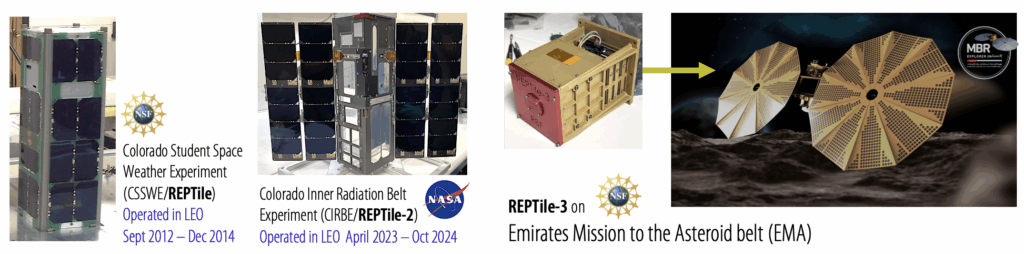
REPTile-3 will operate continuously throughout the mission’s cruise and science phases, measuring SEPs, helium, and electrons across heliocentric distances ranging from from just inside the orbit of Venus, past Mars, and out into the main asteroid belt, over 279 million miles from the Sun (from 0.71 AU to beyond 3 AU). Operating out to 3 AU places REPTile-3 deep within the main asteroid belt, providing a rare and critical vantage point for Heliophysics. By measuring SEPs at these extended distances, the instrument will help scientists track how SEPs diffuse and spread across the solar system, investigate how coronal mass ejection shockwaves continue to accelerate particles in deep space, and gather vital ground-truth radiation data necessary to protect future human exploration missions traversing to Mars and beyond.
The Path Forward for Exploration
Demonstrating the versatility and scalability of HTIDeS investments, the LASP team is already looking beyond the asteroid belt. Dr. Li’s team is currently combining the REPTile-3 architecture with the Medium Energy Electron Telescope (MEET), another HTIDeS-developed (19-HTIDS19-0001) technology, to develop Bidirectional Energetic pArticle Measurements(BEAM). This work will extend there HTIDeS investments toward NASA Moon and Martian exploration through miniaturized radiation measurements and a novel capability to infer subsurface hydrogen—and, potentially, water.
Principal Investigator: Dr. Xinlin Li – LASP/University of Colorado, Boulder
HESTO ID: 17-HTIDS17_2-0028 | Project: Relativistic Electron and Proton Telescope integrated little experiment-2 (REPTile-2)
NASA Artificial Intelligence (AI) Usage Disclosure: This article was created with assistance from AI (ChatGSFC) to summarize content from multiple sources. The resulting article has been reviewed and edited by the author team.