

The Autonomous Ion Mass Spectrometer Sentry (AIMSS) team at Los Alamos National Laboratory (LANL) celebrated the launch of their payload to the International Space Station (ISS) on May 15, 2026. AIMSS was launched as a part of the Department of War (DoW) Space Test Program Houston-11 (STP-H11) mission on SpaceX’s Dragon’s 34th Commercial Resupply Services (CRS-34) mission.
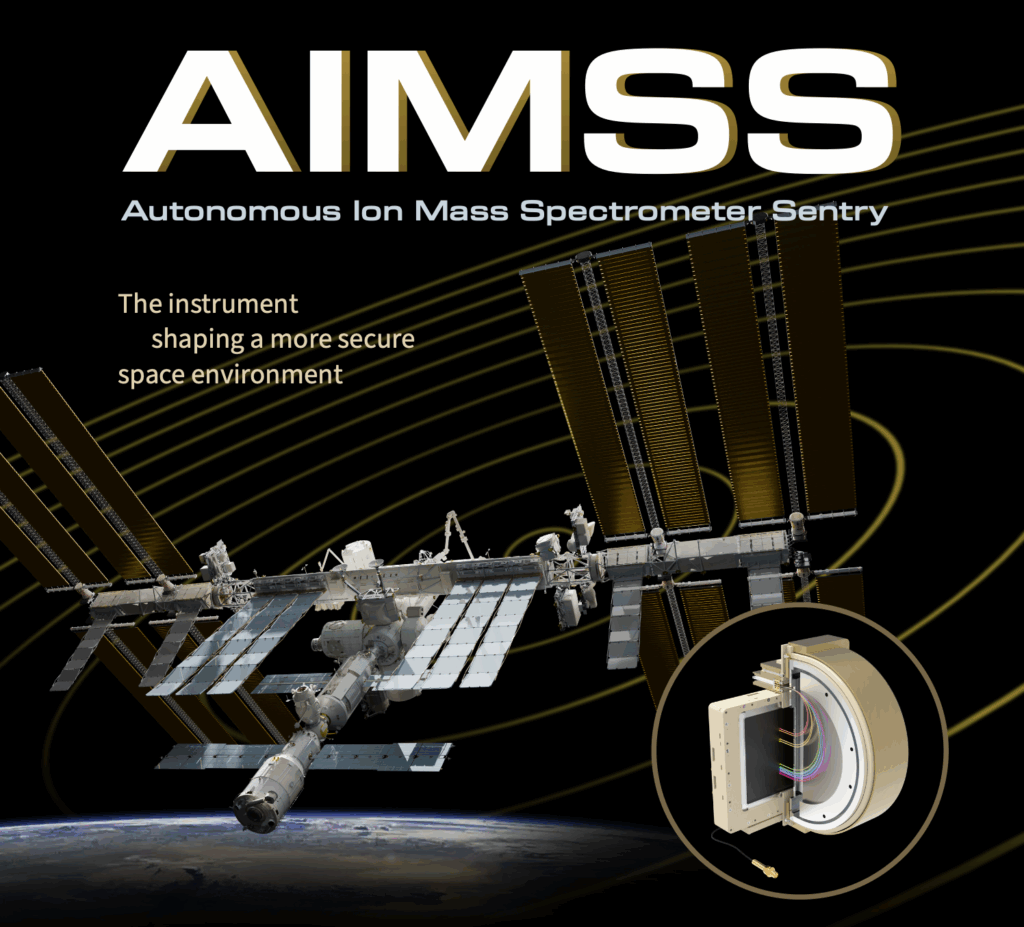
Early on-orbit testing and commissioning of the payload confirmed first light demonstration and O+ ion distributions. The team then worked to optimize the electronics threshold settings and configure the payload for science operations. AIMSS is now actively monitoring ionospheric space plasma and measuring thruster plume contamination to protect the ISS from surface charging and electronic failures.
AIMSS represents a successful technology infusion of the team’s Compact Ion Mass Spectrometer (CIMS) into a spaceflight mission. CIMS (20-HTIDS20-0012) was developed in part through the NASA Heliophysics Technology (HESTO) Heliophysics Technology and Instrument Development for Science (H-TIDeS) program under Principal Investigator Carlos Maldonado (LANL).
The AIMSS team has submitted an entry for the prestigious R&D 100 Award and is currently working on a paper that will be presented at a variety of conferences, including American Institute of Aeronautics and Astronautics (AIAA), Institute of Electrical and Electronics Engineers (IEEE), American Geophysical Union (AGU).
NASA Artificial Intelligence (AI) Usage Disclosure: This article was created with assistance from AI (ChatGSFC) to summarize content from multiple public sources. The resulting content has been reviewed and edited by the author team.