

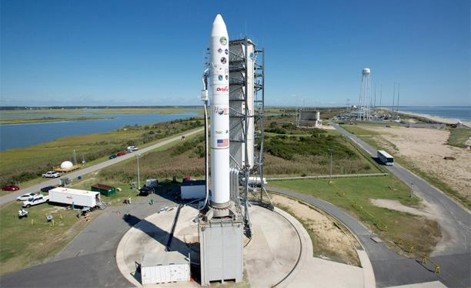
The Lightsheet Anomaly Resolution and Debris Observation – Neuromorphic (LARADO-N) mission, led by Andrew Nicholas from the U.S. Naval Research Laboratory (NRL), successfully launched from Space Launch Complex 8 at Vandenberg Space Force Base in California on April 7, 2026, aboard Space Test Program S29A (STP-S29A) on a Northrop Grumman Minotaur IV rocket.
LARADO-N (22 H-TIDS), funded in part through the NASA Heliophysics Technology (HESTO) Heliophysics Technology and Instrument Development for Science (H-TIDS) program, is designed to use laser light to track millimeter- to centimeter-sized debris objects in space. Such debris is too small to be monitored from the ground but is highly dangerous to operational satellites. This capability is an important advancement for debris mitigation in space and toward protecting the United States’ space-based assets.
Andrew Nicholas is scheduled to provide an update about the LARADO-N mission at HESTO’s upcoming 2026 NASA HELIOTECH and Orbital Flight symposium (August 31-September 4) at the Applied Physics Laboratory in the Baltimore/Washington area.